
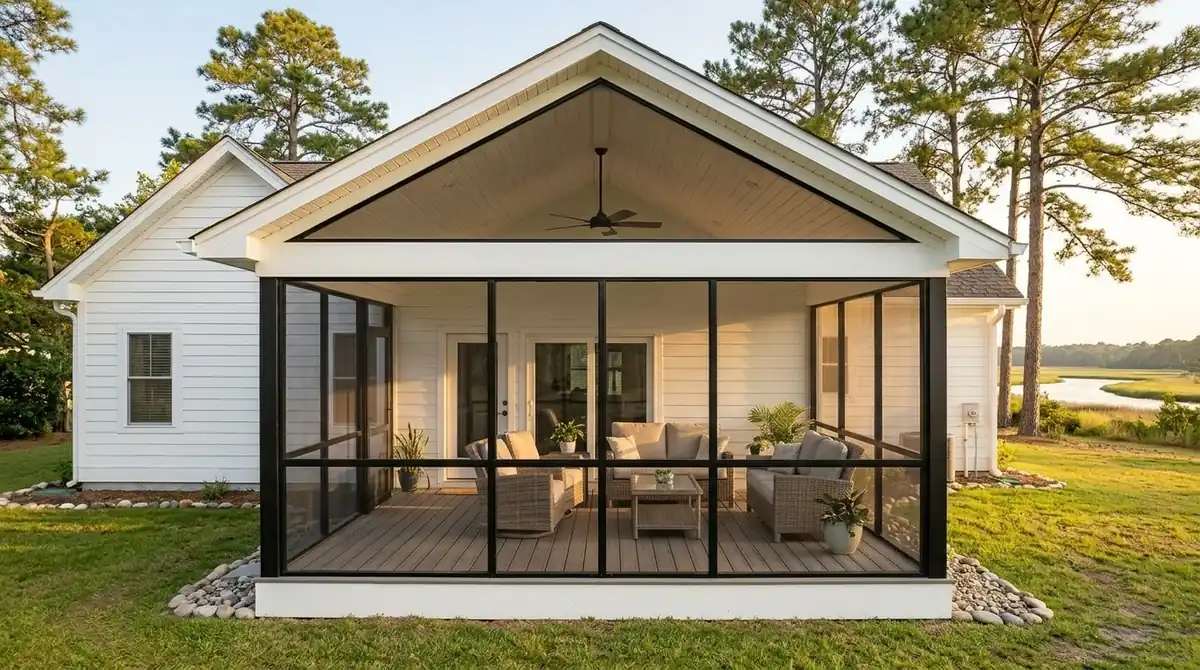
Ask three builders what a sunroom is and you may get three different buildings: a screened porch with vinyl panels, a glass room with no insulation, or a heated and cooled addition with a lot of windows. Most Eastern NC homeowners meet this question on their own deck, swatting mosquitoes.
The screened porch vs sunroom question sounds simple. It is not, because the words hide the real decision: how many months a year the room will be comfortable, what it keeps out and lets in, and how much building code comes with it. This guide explains all three plainly, downsides included, with Eastern NC weather doing the grading. Screen room, porch enclosure, patio enclosure, Florida room: call it what you like, the building underneath is one of these three.
Screened Porch vs Sunroom: The Short Answer First
A screened porch is a roofed outdoor room enclosed only with insect screen. It blocks bugs and gives shade, but it is not insulated or heated or cooled, so its temperature and humidity follow the weather outside.
A 3-season room is a porch enclosed with operable vinyl or single pane glass panels that close against wind, rain and pollen. Uninsulated and unconnected to heating and cooling, it stretches use through spring, summer and fall, not year round.
A sunroom, in the North Carolina Residential Code, is a one story structure attached to a dwelling with glazing over 40 percent of the gross area of its exterior walls and roof. Unconditioned, it counts as a seasonal outdoor room. Conditioned and insulated, a 4-season sunroom is built and permitted like a home addition.
Two questions sort almost every homeowner: must it be comfortable in January and at July midday, and must it count as living space? No to both, and you are shopping for glass you do not need.
The Three Rooms Side by Side
| Screened porch | 3-season room | 4-season sunroom | |
|---|---|---|---|
| What fills the openings | Screen mesh only | Vinyl or single pane panels, plus screens | Insulated Low-E glass, thermal breaks |
| Heated or cooled | No | No (space heaters do not count) | Yes, separate system or separate zone |
| Insulated | No | No, or minimal | Yes: walls, floor and ceiling |
| Bugs | Stopped, if the mesh is right | Stopped | Stopped |
| Pollen | Gets in; fine mesh reduces it | Stopped when panels are closed | Stopped when closed |
| Wind driven rain | Mist and damp get in | Mostly stopped | Stopped |
| Best months in coastal NC | April to October, plus mild winter days | March to November; too hot at July midday when closed | Year round, if sized for glass |
| Counts as living space | Never | No | Only if permitted, insulated and conditioned |
| Relative cost | Lowest | Middle | Highest, addition level scope |
What a Screened Porch Really Gives You
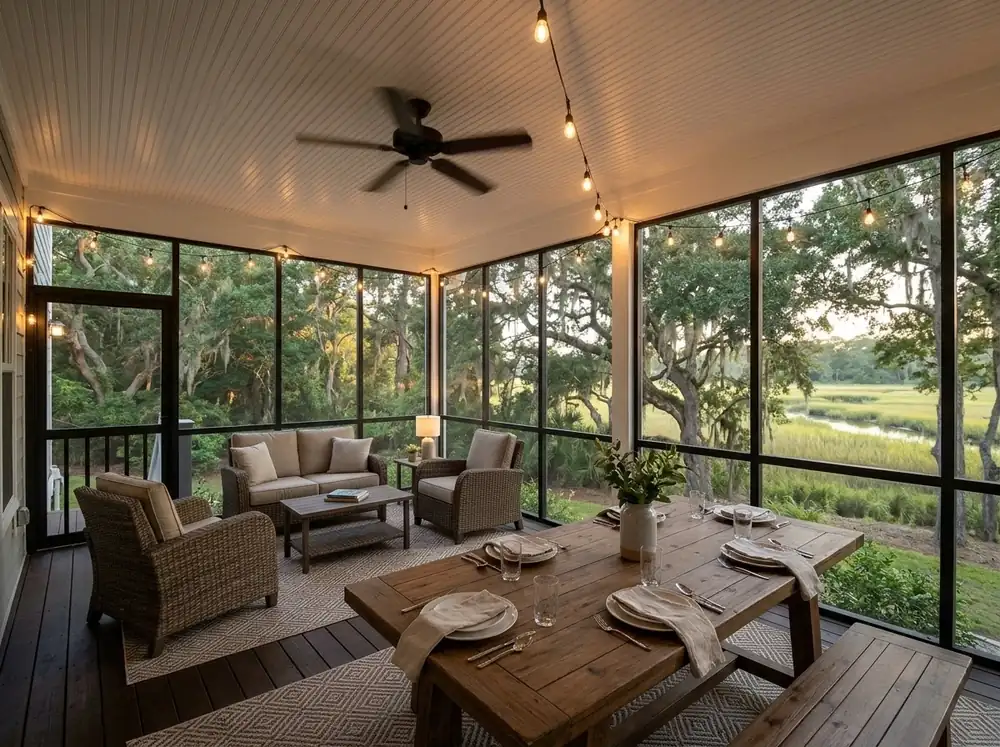
A screened porch is the honest room of the three: it promises breeze, shade and bug free evenings, and delivers exactly that. On a July evening near the Pungo River, it is the best seat in the house: shade, a ceiling fan, and dinner without negotiating with mosquitoes.
The details decide whether yours works. Screen systems like Screen Tight hold mesh in a base with a spline and snap on cap instead of staples, so panels stay tight and replacements are simple. Add a draining floor, a properly tied roof, and hardware that resists brackish air. What it will not do: stop pollen, stop wind driven rain completely, or hold heat in January.
What a 3-Season Room Adds, and What It Quietly Takes Away
A 3-season room starts life as a porch and swaps open screen for panels you can close. One widely used system is Eze-Breeze by PGT: vertical four track panels glazed with 10 mil flexible vinyl, not glass, sliding open up to 75 percent of the wall and removable entirely. In spring, fall, and rainy summer days, that flexibility is useful. Close them and pollen and sideways rain stay out; open them and your porch is back.
Now the parts brochures soften, and these apply to vinyl panel systems generally, not to one brand. Tracks collect pollen and grit, so panels stick if not kept clean. Vinyl clouds with ammonia based cleaners or gritty cloths, and stiffens in cold weather. Owner discussions add the rest: worn latches, panels that drop or tilt in high wind, top panels needing a step stool, and panels that can fall out during cleaning. It is a moving parts choice, and moving parts need upkeep.
The name deserves a raised eyebrow: in a hot climate, an unconditioned glass or vinyl room honestly behaves like a 2-season room, because the months it loses are the summer ones.
The Sunroom, the 4-Season Room, and the 40 Percent Rule
North Carolina actually defines this one. Under the state residential code interpretation for sunrooms (section R303.10), a sunroom is a one story attached structure where glazing covers more than 40 percent of the gross area of the exterior walls and roof. Below that line, a room opening to the house is no sunroom in code terms, and must meet the dwelling’s insulation and heating rules.
A 4-season sunroom earns the name with unglamorous things: insulated walls, floor and ceiling, double pane Low-E glass, thermally broken frames, a proper foundation, and its own heating and cooling. That is an addition with a view. It can also be the most expensive way to discover that what you wanted was a bug free place to drink coffee in May. Many local families who need conditioned space price a framed home addition instead.
Federal energy guidance on windows puts the share of sunlight entering as heat through ordinary double pane glass at roughly three quarters, so a west facing glass room in Greenville can bake in August. Cooling one is a design decision: energy rules expect a conditioned glass room kept thermally separate, cooled by its own right sized system or mini split, never by extending house ducts.
How Many Months Will You Actually Use Each Room Here?
Forget national charts. Use New Bern weather (NOAA climate normals): January highs in the mid 50s, July highs near 90 with morning humidity near 80 percent, and roughly 53 inches of rain a year.
Against that calendar, a screened porch earns its keep from April through October, plus mild winter days. In July and August it is a morning and evening room; a ceiling fan is not optional. Local coastal builders put the comfortable season at eight to nine months.
A 3-season room extends the shoulders: March and November, rainy days rescued, and the pollen weeks closed out. It does not add July midday with panels closed, and January evenings stay cold behind vinyl. Only a 4-season sunroom adds all twelve months, and only when its heating and cooling was sized for glass. For summer evenings outside, it is machinery pointed at the wrong problem.
Bugs, Pollen, Rain, Humidity and Hurricanes: The Eastern NC Tests
Bugs. Standard mesh (18 by 14 or 18 by 16 strands per inch) stops mosquitoes and gives the best airflow and view. It does not stop no-see-ums, the biting midges of the marsh and river edges. Near the water, 20 by 20 no-see-um mesh is the right call; it costs a little airflow, which a ceiling fan hands back.
Pollen. Screens do not stop pollen. Tree pollen runs February through May, and pine pollen peaks in early April, coating cars and porch floors in yellow film. If pollen is the enemy, the honest answers are panels that close, or weeks of hosing down porch furniture.
Rain. Wind driven rain comes through screen as mist, dampening cushions well inside the roofline in a hard Pamlico storm. The fixes are design: a knee wall of 24 to 36 inches, a generous roof overhang, a floor sloped to drain.
Humidity. In a 3-season room, warm wet air condenses on cooler panels; left alone, that is how the mildew smell starts. Ventilate when you can; a small dehumidifier holding 40 to 50 percent humidity is cheap insurance. In a screened porch, choose outdoor rated furniture and fabrics. Indoor furniture moved onto a porch here will mildew.
Hurricanes and wind. Atlantic hurricane season runs June through November, and it grades these rooms hardest. Screen is the sacrificial layer: cheap to replace after a storm. Vinyl panels are not storm rated, so before a major storm they come out and get stored inside, as manufacturers advise. A glass sunroom is different: it must be engineered for the design wind speed at your address, roof tied down, and that number comes from your county, not a brochure.
Permits, Foundations and Code in North Carolina
This is the section national articles skip, and it protects your money. A new attached screened porch needs a building permit in practice, and wiring adds an electrical permit; a sunroom adds mechanical permits and energy inspections. Do not let anyone wave the $40,000 permit exemption at you: state law (G.S. 160D-1110) excludes load bearing, HVAC, electrical and new roofing work, which is most of what a new porch or sunroom is.
Foundations follow the structure. A new sunroom is treated like an addition and, in the county guidance we reviewed, sits on a permanent foundation. Screening an existing deck surprises homeowners: walls and a roof change its wind load, so expect new footings or a structural analysis by a licensed engineer. Setbacks, easements, septic systems, impervious surface limits, HOA review and flood zone rules all get checked before anyone digs.
Does It Count as Living Space, and Does It Add Value?
Honest answer, because resale claims get inflated fast. Under the appraisal standard (ANSI Z765), a screened porch never counts as gross living area, and a 3-season room does not count either. Only permitted, insulated, permanently conditioned space counts: a true 4-season build. The other two add amenity value, not square footage: listing photos sing, but appraisals adjust rather than count. Treat any single return percentage with suspicion; published figures disagree wildly.
Two smaller consequences rarely make the brochure. The room behind your new porch or glass wall gets darker, because a deep roof and closed panels take real daylight from it. Nor should an unconditioned glass room be promised as a study or TV room; summer heat is hard on electronics and attention spans.
Start Screened Now, Convert Later: How That Actually Works
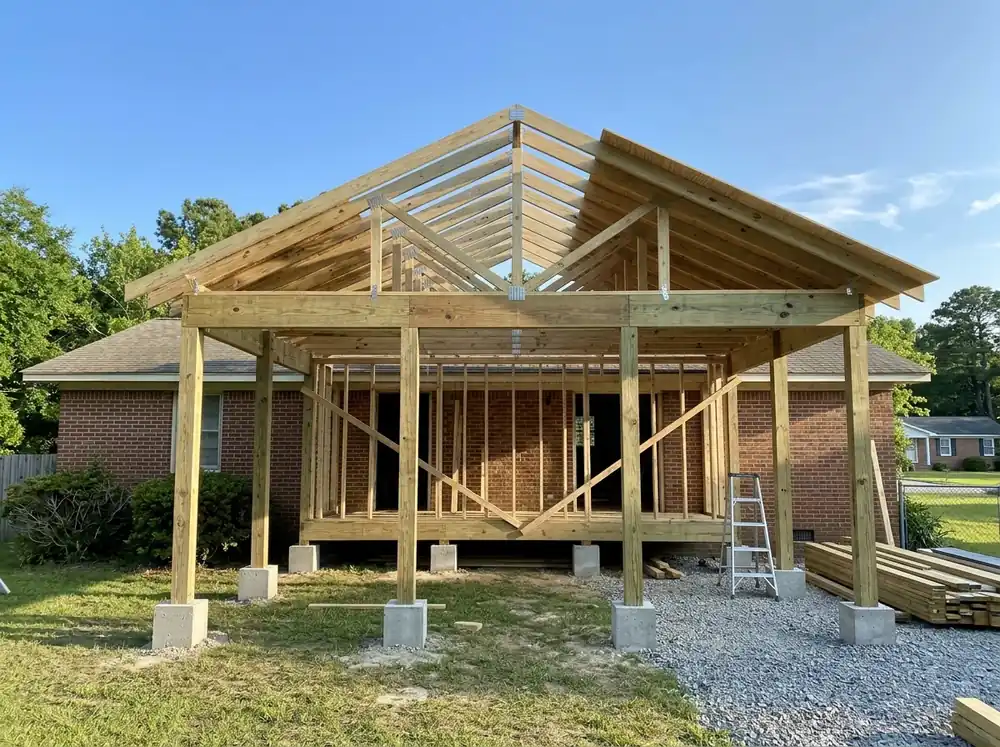
Can you build a screened porch today and turn it into a sunroom later? Sometimes, yes. The answer lives in footings, posts, roof ties and the wind load solid walls add, not in the panels. Honest assessments end three ways: convert, reinforce first, or rebuild. Deciding now makes it cheaper: footings sized for the future load, standard openings, and a roof tied down for walls. Get that in writing before the first post goes in.
How to Choose: Five Questions That Settle It
Work through these in order, and the screened porch vs sunroom debate usually ends on its own.
- Which months are you really buying? Spring through fall evenings are covered. Glass buys the shoulders. Only conditioning buys January.
- What bothers you most: bugs, pollen, rain or cold? Bugs point to mesh, pollen and rain to closable panels, cold to a conditioned room.
- How close are you to water or marsh? The closer you sit, the more the 20 by 20 mesh and corrosion resistant hardware matter.
- Do you need the square footage to count? An office or suite that must list as living space means a permitted, conditioned build.
- What do you already have? A sound deck or porch can be screened in at the lowest relative cost here. A tired structure changes the math.
A word on cost: we do not publish prices here, and published ranges disagree by wide margins. What is consistent in every screened porch vs sunroom guide is the order: screen in first, then new screened porch, vinyl conversion, 3-season build, and 4-season sunroom at addition level. What moves your number: roof, footings, glazing, insulation, heating and cooling, permits.
What We Build, Stated Plainly
Prado’s Home Improvement builds new screened porches and screens in existing decks and porches across Belhaven, Washington, Chocowinity, Bath, Greenville and New Bern. We would rather explain the other two honestly than pretend the porch is always the answer. Johan and Kevin Prado lead the local crew, with 15 years of home improvement experience, and every project starts with a free estimate at your home.
Standing on that deck wondering? Start with the five questions above. Then, if a screened porch or a screen in is where you land, see our screened porch projects and talk to our screened porch builders in Belhaven NC about your lot, or see what screening in an existing deck involves before you request your free estimate.
Frequently Asked Questions
Can a screened porch be turned into a sunroom later?
Sometimes. It depends on footings, posts, roof structure and wind load. Designing for glass early keeps a conversion affordable.
Is a sunroom worth it?
Yes, if you need conditioned space that counts as living area. Otherwise a porch gives the same months for far less.
Does a screened porch add value to a home?
It adds amenity value, but never living area; only permitted, insulated, conditioned space counts as square footage.
Do I need a permit to screen in a porch in North Carolina?
Usually, yes. A new attached porch needs a building permit, and wiring needs an electrical permit. Screening an existing roofed porch with no structural or electrical work may fall under the $40,000 exemption, but adding a roof, footings or wiring does not. Confirm with the Beaufort, Pitt or Craven county inspections office.
Does a 3-season room need a foundation or heating and cooling?
No heating or cooling; that is what makes it 3-season. Existing decks may need new footings or an engineer’s check.
Will a screened porch keep out pollen and no-see-ums?
Pollen, no; only closed panels stop it. No-see-ums, yes, with fine 20 by 20 mesh.
Why does a sunroom get so hot, and what does cooling one involve?
Glass admits most of the sun’s heat, so the room heats far faster than the house. Cooling takes low solar gain glass, shade, and its own system.
Can a sunroom have screens?
Yes. Most designs place screens behind the panels, so it opens to fresh air. In a screened porch, the screen is the wall.
What is the difference between a 3-season room and a 4-season room?
A 3-season room uses vinyl or single pane panels, unheated and uncooled. A 4-season room adds insulation, Low-E glass and heating and cooling.